DRC Trade Overview

The Democratic Republic of Congo (DRC) is a vast country with immense, largely untapped economic potential. While it is globally recognised for its unparalleled mineral wealth, the DRC is committed to diversifying its economy and formalising its extensive informal trade networks. With a large population, extensive river systems, and a strategic location that borders nine countries, the DRC has the potential to become a major hub for regional trade in agriculture and manufactured goods. The current focus is on rebuilding infrastructure and developing value chains to convert its resource wealth into broad-based economic growth. Political instability and conflict risk pose serious challenges to such endeavours.

DRC Trade Fact & Figures

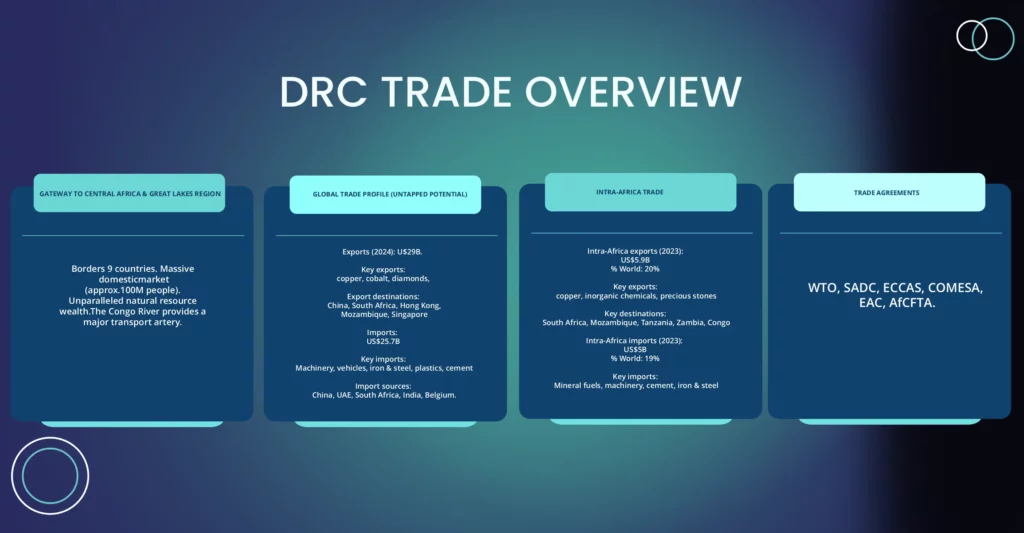
US$29B
Exports (2024)
Key exports: copper, cobalt, diamonds Export destinations: China, South Africa, Hong Kong, Mozambique, Singapore
US$25.7B
Imports
Key imports: Machinery, vehicles, iron & steel, plastics, cement Import sources: China, UAE, South Africa, India, Belgium
US$5.9B
(20% World)
Intra-Africa Exports (2023)
Key exports: copper, inorganic chemicals, precious stones, mineral fuels, cobalt Key destinations: South Africa, Mozambique, Tanzania, Zambia, Congo
US$5B
(19% World)
Intra-Africa Imports (2023)
Key imports: Mineral fuels, machinery, cement, iron & steel Key sources: South Africa, Tanzania, Zambia, Eswatini

Why Trade with the DRC

Incredible Hydropower Potential
A Market of Continental Scale

With a population approaching 100 million, the DRC is one of Africa's largest consumer markets, offering enormous scale for a wide variety of goods and services.

Future Breadbasket of Africa
The Future Breadbasket of Africa

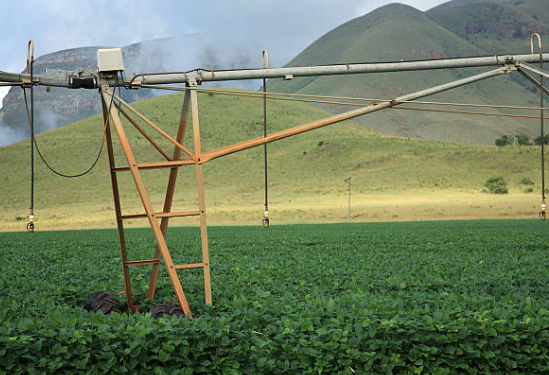
The DRC possesses over 80 million hectares of fertile arable land and abundant water resources, giving it the potential to not only be self-sufficient in food but to be a major agricultural exporter to the rest of the continent.

Strategic Hub for Intra-African Trade

The DRC's location makes it a natural nexus for trade between Southern, Eastern, Central, and Western Africa. Developing its infrastructure will unlock major new trade routes.

Market of Continental Scale
Global Significance in Strategic Minerals

The DRC is the world's largest producer of cobalt and a major producer of copper, materials that are critical for the global green energy transition and electronics industries.

Global Significance in Strategic Minerals
Incredible Hydropower Potential

The Congo River, with the construction of the Inga Dam project, has the largest untapped hydroelectric potential in the world, with the potential to power much of the continent and support energy-intensive industries.

A Focus on Formalisation
A Focus on Formalisationwewewe

The government, with international support, is working to formalise the economy and improve customs and trade procedures, which will create a more predictable environment for international traders.

DRC: Powering Global Trade from the Heart of Africa

Trade Policy Framework: An Open & Integrated Approach

The DRC is committed to regional and continental economic integration, leveraging its strategic position through membership in key trade blocs. This framework is designed to lower tariffs, simplify trade rules, and attract foreign investment.

Global & Continental Integration
  • Global Membership: As a member of the World Trade Organisation (WTO) since 1997, the DRC is provided with a framework for economic reform and greater integration into the global economy, a benefit it is actively leveraging by recently ratifying the Trade Facilitation Agreement to reduce costs and modernise its customs procedures.
  • Continental Integration (AfCFTA): The African Continental Free Trade Area (AfCFTA) is a cornerstone of the DRC's policy. Having ratified the agreement, the DRC has validated its national implementation strategy. The focus is now on finalising its tariff reduction offer, which will open access to a market of 1.4 billion people.
Regional Economic Blocs

Regional Economic Blocs:

  • SADC (Southern African Development Community): Provides preferential access to markets in Southern Africa.
  • COMESA (Common Market for Eastern and Southern Africa): Offers trade benefits and integration with Eastern and Southern African economies.
  • ECCAS (Economic Community of Central African States): Deepens ties with neighbouring Central African nations.
Legal & Business Harmonisation (OHADA)

Legal & Business Harmonisation (OHADA): As a member of the Organisation for the Harmonisation of Business Law in Africa (OHADA), the DRC offers a secure, transparent, and modern legal framework for investors and traders, standardizing commercial, corporate, and accounting laws.

Trade Potential: Beyond Raw Materials to Value Creation

The DRC's trade potential is monumental, with a strategic pivot from exporting raw commodities to developing sophisticated manufacturing and processing capabilities. The goal is to capture more value domestically, creating jobs and fostering industrial growth.

Current Trade Snapshot:

  • Primary Exports: Dominated by raw minerals, primarily Copper ($15.1B) and Cobalt ($6.3B).
  • Key Imports: Refined Petroleum, Machinery, Pharmaceuticals, and Food Products, highlighting a major opportunity for import substitution and local manufacturing.
Focus on Manufacturing & Value Addition

Focus on Manufacturing & Value Addition:

  1. The Battery Value Chain Revolution:
    • Global Epicentre: The DRC holds over 70% of the world's cobalt reserves and significant lithium deposits.
    • DRC-Zambia Battery Council: A landmark partnership with Zambia to develop an integrated value chain, from mining to producing battery precursors and eventually full EV batteries.
    • Special Economic Zones (SEZs): A transboundary SEZ is under development with Zambia to house manufacturing plants, creating a "battery belt" in the heart of Africa.
  2. Harnessing Agricultural Wealth:
    • Untapped Potential: Possesses 80 million hectares of arable land and significant water resources yet imports over $1.5 billion in food annually.
    • Value Addition Focus: Investment is targeted at processing key crops like coffee, palm oil, cocoa, and cassava for export and local consumption, reducing import dependency.
  3. Green Energy Manufacturing:
    • Hydropower Powerhouse: With over 100,000 MW of potential hydropower, the DRC can power its industrial ambitions and export clean energy.
    • Manufacturing Hub: This cheap, abundant energy is a key enabler for energy-intensive manufacturing, including green hydrogen production and minerals processing.
Trade Facilitation: Building the Arteries of Commerce

Trade Facilitation: Building the Arteries of Commerce. Recognising that potential is unlocked by efficiency, the DRC and its partners are heavily invested in overcoming logistical hurdles and streamlining the movement of goods.

  • Infrastructure Transformation - The Lobito Corridor:
    • This strategic rail line is being revitalised with support from the U.S. and the EU.
    • It provides a direct, faster, and more reliable route for minerals from the Katanga province to the Port of Lobito in Angola, bypassing traditional, congested routes.
    • Impact: Reduces transport time by days, lowers logistics costs, and enhances export competitiveness.
  • Streamlining Customs & Border Processes:
    • Single Window (GUICE): The Guichet Unique Intégral du Commerce Extérieur acts as a single point of submission for all trade-related documents, aiming to increase transparency and reduce processing times and costs for importers and exporters.
    • Border Modernisation: Ongoing efforts to upgrade key border posts with modern technology and harmonised procedures with neighbouring countries to facilitate smoother cross-border trade.
  • Addressing Challenges:
    • Logistics Performance: While improving, the DRC is focused on enhancing its Logistics Performance Index score by investing in infrastructure, customs efficiency, and logistics service quality.
    • Cost of Trade: Efforts are concentrated on reducing non-tariff barriers and informal costs associated with moving goods internally and across borders.
    • Regional Tensions: High political and military tensions with neighbouring countries, as recently witnessed, particularly with Rwanda, can escalate into larger conflicts that disrupt regional trade routes and create unpredictable operating environments.
    • Conflict in the East: The eastern provinces (like North and South Kivu and Ituri) are plagued by armed conflict involving numerous domestic and foreign armed groups. This poses a direct risk of violence, kidnapping, and loss of life or assets for business personnel.

DRC Trade News

DRC Investment Overview

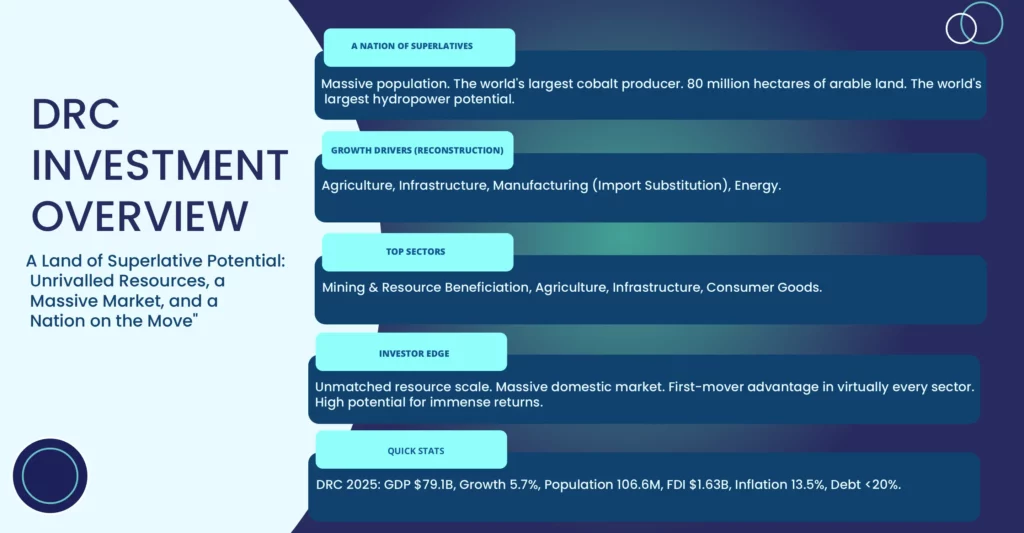
Investing in the DRC presents a high-risk, high-reward opportunity with exceptional long-term potential. This investment narrative focuses on rebuilding the nation and tapping into one of the world's last great frontier markets. While the mining sector has historically attracted the most foreign direct investment (FDI), the most significant future opportunities lie in foundational sectors such as agriculture, infrastructure, manufacturing, and energy. The government is actively seeking private investment to help unlock this potential, with the National Investment Promotion Agency (ANAPI) serving as the primary gateway for investors.

DRC Investment Facts & Figures

The DRC consistently attracts some of the highest FDI inflows in Africa, driven largely by global demand for copper and cobalt — key inputs for the global energy transition and EV battery supply chains.

2024 est.
US$3.11 B
FDI Inflow (Realised)

UNCTAD estimate — up ~21% from 2023, driven by ongoing mining expansion.
2024 est.
US$36.68 B
FDI Stock

Cumulative value of foreign investments, mostly concentrated in the extractive sector.

2024 est.
33.43%
Gross Capital Formation

Share of GDP — among the highest in Africa, reflecting heavy capex in mining mega-projects.

2019–2023
Top-tier in Africa
FDI Inflows (Regional Position)

The DRC remains one of Africa’s major FDI destinations, almost exclusively linked to copper & cobalt.

Top Investors (by committed capital, 2019–2023)

  • China — large mining consortia and infrastructure-for-minerals arrangements.
  • Great Britain (UK) — diversified mining holdings and services.
  • Egypt — growing participation in resource-linked and services projects.
  • Mauritius — holding structures and regional financial vehicles.
  • India — mining, trading and processing value-chain investments.

Based on ANAPI-registered projects; consolidated trends from ANAPI and Lloyds Bank Trade (2023).

Where is the FDI Going? (Top Sectors)

  1. Services 44.8% of committed FDI

    Logistics, financial services and telecommunications that enable and support the mining industry.

  2. Industry 40.7% — Mining-led

    Extractive mining (copper, cobalt) plus manufacturing inputs and processing activities.

  3. Infrastructure 8.5%

    Energy (especially hydroelectric projects) and strategic transport corridors (Lobito, Dar es Salaam).

  4. Agriculture 5.9%

    A smaller but growing focus on modernising food production and agri-value chains.

Notes: Realised FDI is still overwhelmingly in mining, but committed investment data shows emerging diversification across services, infrastructure and agriculture. Annual and multi-year metrics provide a clearer trend than individual project announcements.

Why Invest in The DRC

Unparalleled Mineral Resources
Unparalleled Mineral Resourceswewewe
The DRC holds globally significant reserves of cobalt (essential for EV batteries), copper, diamonds, gold, coltan, tin, lithium, and many other minerals, making it a prime destination for mining investment.
Immense Hydropower Potential
Immense Hydropower Potential (Grand Inga Project)
The Congo River has the potential to generate over 100,000 MW of hydropower, with the Grand Inga site alone capable of producing around 44,000 MW, offering transformative energy opportunities for the continent.
Vast Untapped Agricultural Land
With 80 million hectares of arable land, diverse agro-ecological zones, and abundant water, the DRC has the potential to become a major food producer and exporter, offering opportunities in large-scale farming and agro-processing.
Large and Growing Consumer Market
Large and Growing Consumer Marketwewewwwwe
A population of over 100 million, with a high proportion of young people, represents a substantial and rapidly growing domestic market for goods and services.
Strategic Infrastructure Development
Strategic Infrastructure Development Needs and Opportunities
Massive investments are required in transport (roads, rail, ports, river navigation), energy (generation, transmission, distribution), water, and urban infrastructure, creating significant opportunities for investors and PPPs.
Developing Forestry Sector
Developing Forestry Sectorwewwwwwwwewe
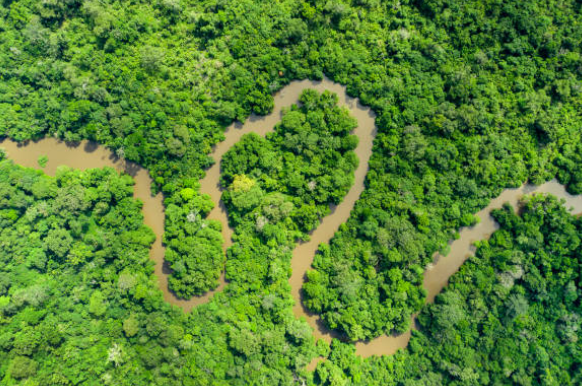
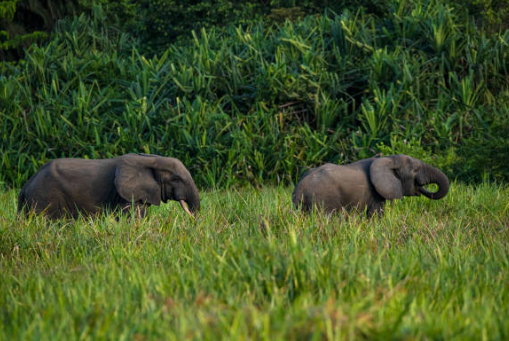
The DRC has the second-largest tropical rainforest in the world, offering potential for sustainable forestry management, timber processing, and carbon credit projects, though requiring responsible and sustainable practices.
Government Investment Support
Government Commitment to Attracting Investment
The National Agency for Investment Promotion (ANAPI) is dedicated to facilitating investment, and the government has been working on improving the legal and regulatory framework, including adherence to OHADA (Organisation for the Harmonisation of Business Law in Africa).
Emerging Manufacturing and Services
Emerging Manufacturing and Services Sector
Opportunities are growing in import substitution manufacturing (food processing, beverages, construction materials, light assembly) and services (telecommunications, banking, logistics, tourism) to cater to the large domestic market.

Key Investment Sectors in The DRC

Mining
Mining (Cobalt, Copper, Gold, Diamonds, Coltan, Lithium, etc.)
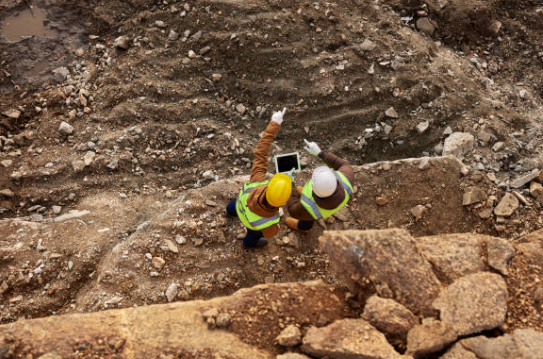
World-leading producer of cobalt, major copper and diamond exporter. Significant deposits of gold, coltan, tin, tungsten, lithium, and manganese. Exploration, extraction, processing, and value addition.
Energy
Energy (Hydropower, Solar, Biomass)
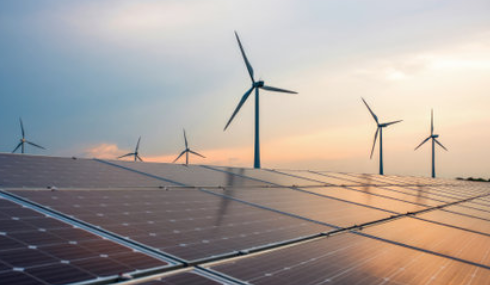
Vast hydropower potential (Inga dams). Growing interest in solar for off-grid and utility-scale, biomass. Opportunities in generation, transmission, and distribution.
Agriculture
Agriculture & AgribusinessReplacement
Coffee, cocoa, palm oil, rubber, sugar, cassava, maize, rice, timber. Potential for large-scale commercial farming, agro-processing, livestock, and fisheries.
Infrastructure
Infrastructure (Transport, Construction, ICT)
Roads, railways, river ports (Matadi, Boma, Kinshasa), airports. Urban development, housing. Telecommunications infrastructure (fiber optics, mobile towers).
Manufacturing
ManufacturingReplacement Text here
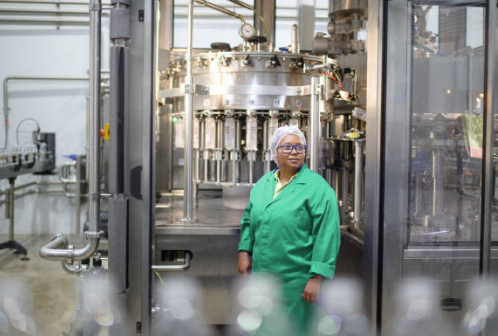
Food processing, beverages, brewing, cement, construction materials, plastics, chemicals, pharmaceuticals, and assembly. Special Economic Zones (e.g., Maluku SEZ) aim to boost this sector.
Forestry
Forestry & EnvironmentReplacement
Sustainable logging, timber processing, reforestation, carbon credit projects, and conservation. Requires strict adherence to environmental and social governance.
Tourism
Tourism (Developing)
Unique biodiversity (Virunga, Garamba, Salonga, Kahuzi-Biega National Parks – home to mountain gorillas, okapis, etc.), Congo River expeditions, cultural heritage. Requires peace, security, and infrastructure development.

Investment Incentives and Support(Facilitated by ANAPI and specific zone regimes)

These incentives support regional development, integration, and competitiveness across Southern Africa in alignment with Malawi's economic cooperation goals.

Tax & Customs Incentives (As per Investment Code & SEZ regulations)

  • Exemptions from import duties on machinery, equipment, and inputs. Tax holidays or reduced corporate income tax rates for eligible projects, particularly in SEZs or priority sectors. VAT exemptions. Accelerated depreciation.



Financial & Operational Support

  • Access to land, particularly within designated Special Economic Zones (SEZs). Facilitation of work permits for expatriate staff. Guarantees against expropriation. Right to repatriate profits and capital (subject to regulations).

Business Support & Facilitation

  • ANAPI as the primary agency for investment promotion, registration, and facilitation. Assistance with obtaining licenses and permits. Support for navigating administrative procedures. GUICE for trade facilitation.

Success Stories

Illustrative examples given the scale of the economy; focus on potential and established niches

Major Copper and Cobalt Mining Operations

Several large international mining companies operate significant copper and cobalt mines in the Katanga region, making the DRC a critical global supplier of these strategic minerals.

Telecommunications Sector Growth

The mobile telecommunications market has seen substantial growth with multiple operators investing heavily in network expansion and services, driving connectivity across the country.

Hydropower Development (Existing & Planned)

Existing Inga I and Inga II dams contribute significantly to the power supply, with ongoing efforts and international interest in developing the larger Grand Inga project.

Investment News

New CEO appointed to DRC's National Economic Council

DRC Appoints New CEO to Lead National Economic Council

May 2, 2025
Innovation and green economy summit in Kinshasa, DRC

Kinshasa Hosts Regional Summit on Innovation and the Green Economy

April 29, 2025
Trade forum promoting cross-border collaboration in Central Africa

DRC Leads Cross-Border Trade Talks with Angola and Zambia

April 25, 2025
Map of mineral-rich provinces in the DRC

Strategic Mineral Development Zones Identified Across DRC

April 23, 2025

DRC Technology Overview

Investing in the DRC presents a high-risk, high-reward opportunity with exceptional long-term potential. This investment narrative focuses on rebuilding the nation and tapping into one of the world's last great frontier markets. While the mining sector has historically attracted the most foreign direct investment (FDI), the most significant future opportunities lie in foundational sectors such as agriculture, infrastructure, manufacturing, and energy. The government is actively seeking private investment to help unlock this potential, with the National Investment Promotion Agency (ANAPI) serving as the primary gateway for investors.

Technology Facts & Figures

The DRC's technology sector is rapidly emerging, driven by a large, youthful population and increasing mobile connectivity. Kinshasa and Lubumbashi are key centres for tech activity. While challenges in infrastructure exist, the potential for leapfrogging with digital solutions is immense. The government has a National Digital Plan (Plan National du Numérique Horizon 2025) to guide this transformation.

23%
Internet Penetration
Population with Internet Access (2023)
52%
Mobile Subscription
Active mobile users in DRC (2023)
17
Tech Hubs
Innovation & startup centers across the country
3.1%
ICT Contribution
To DRC’s GDP (2023 est.)
5
Key Tech Sectors
Including Fintech, eLearning, AgriTech, HealthTech, E-commerce
0.7%
Fixed Broadband
Estimated household penetration (2023)

Technology Sectors in The DRC

Information Technology
Telecommunications & ICT Infrastructure
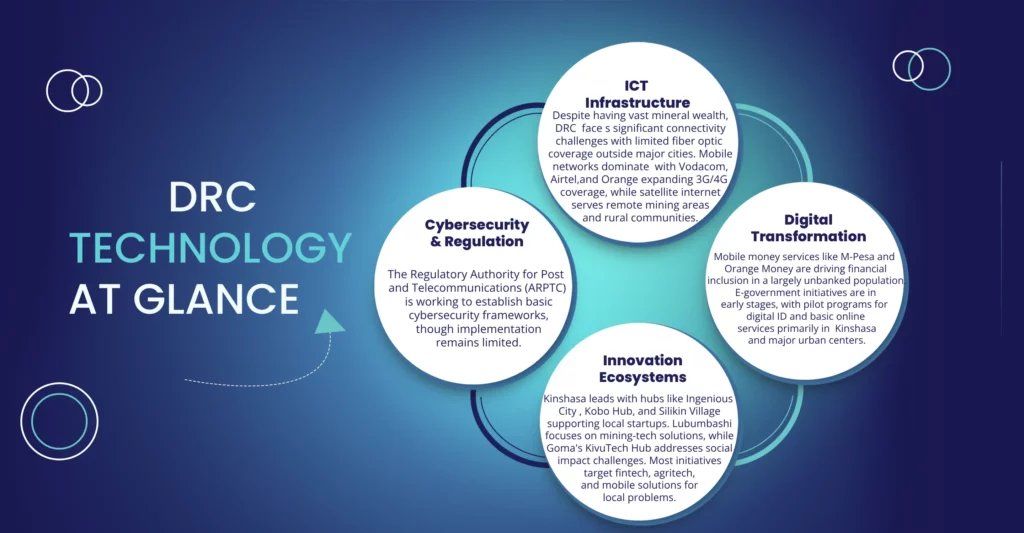
Mobile network operators are expanding 3G, 4G, and exploring 5G coverage. Investment in fibre optic backbones, data centres, and last-mile connectivity is critical. Satellite services also play a role in remote areas.
Financial Technology
FinTech & Digital Payments
Mobile money is a key driver of financial inclusion in a largely unbanked population. Payment gateways, digital lending, and insurtech are emerging, with significant room for growth.
Agricultural Technology
AgriTech & Resource Management
Technology can revolutionise agriculture through mobile advisory services, climate data, supply chain traceability (especially for commodities like coffee and cocoa), and precision farming techniques. Similar applications exist for sustainable forestry and fisheries.
Mining Technology
MiningTech & Supply Chain Transparency
Technology is crucial for optimising mining operations, enhancing safety, and improving transparency in mineral supply chains (e.g., blockchain for traceability of cobalt and coltan).
Health Technology
HealthTech & Digital Health
Given the healthcare challenges, HealthTech offers significant potential through telemedicine, electronic health records, disease surveillance systems, and logistics for medical supplies.
Education Technology
EdTech (Education Technology)
Digital learning platforms, online educational content, and teacher training tools are vital for improving access to and quality of education across the vast country.
Government Technology
E-Government Services & CivicTech
Digitisation of public services (registrations, permits, tax collection) aims to improve efficiency, reduce corruption, and enhance citizen engagement.
Logistics Technology
LogisticsTech & E-Commerce
Technology can help overcome logistical challenges for e-commerce, transport management, and supply chain efficiency, particularly given the DRC's size and infrastructure gaps.
Renewable Energy Technology
Renewable EnergyTech & Smart Grids
Technology is key for managing and distributing power from large hydro projects and integrating smaller-scale renewable sources like solar. Smart metering and off-grid solutions are vital.

Leading Technology Hubs & Initiatives

Kinshasa
Kinshasa: The Capital and Primary Tech Hub
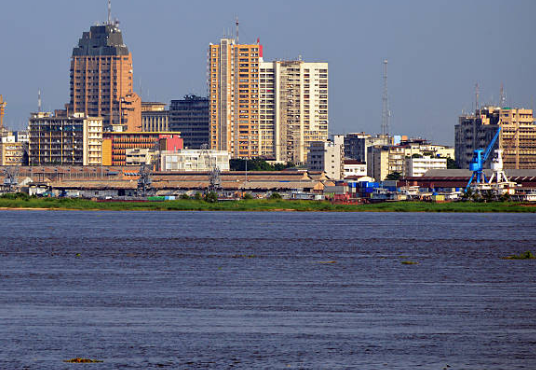
As the largest city and economic centre, Kinshasa hosts the majority of tech startups, innovation hubs (e.g., Ingenious City, Kobo Hub, Silikin Village), co-working spaces, tech events, and has the highest concentration of developers and venture capital interest.
Lubumbashi
Lubumbashi: Mining Region Tech & Innovation Focus
As the capital of the Haut-Katanga province and a major mining centre, Lubumbashi has a growing tech scene, often with solutions tailored to the mining industry, logistics, and regional economic needs. Some incubators and tech training centres are present.
Goma
Goma: Emerging Hub with a Focus on Social Impact & Connectivity
Located in Eastern DRC, Goma has seen the rise of tech initiatives and hubs (e.g., KivuTech Hub) often focused on social impact, peacebuilding, and leveraging technology to address local challenges, including connectivity in a complex environment.
Bukavu
Bukavu: Developing Tech Scene
Similar to Goma, Bukavu in South Kivu is also developing a local tech ecosystem with a focus on community solutions and digital skills.
National Digital Plan
National Digital Plan & Regulatory Framework
The government's "Plan National du Numérique Horizon 2025" and efforts by the Regulatory Authority for Post and Telecommunications (ARPTC) aim to create a more favourable environment for ICT development, investment in digital infrastructure, and digital skills enhancement.
University Programs
University Programs & Tech Training Centres
Universities in Kinshasa, Lubumbashi, and other cities, along with specialised tech training centres, are increasingly focusing on developing ICT skills to meet the growing demand from the tech sector.

The DRC Technology News

Unlock The Potential Of The DRC

The Democratic Republic of Congo offers vast natural resources and a rapidly growing market with immense potential for businesses involved in international trade. By taking advantage of the FTA benefits and regional economic initiatives, businesses can grow their footprint, improve competitiveness, and support the sustainable development of the region.

This website uses cookies and asks your personal data to enhance your browsing experience. We are committed to protecting your privacy and ensuring your data is handled in compliance with the General Data Protection Regulation (GDPR).